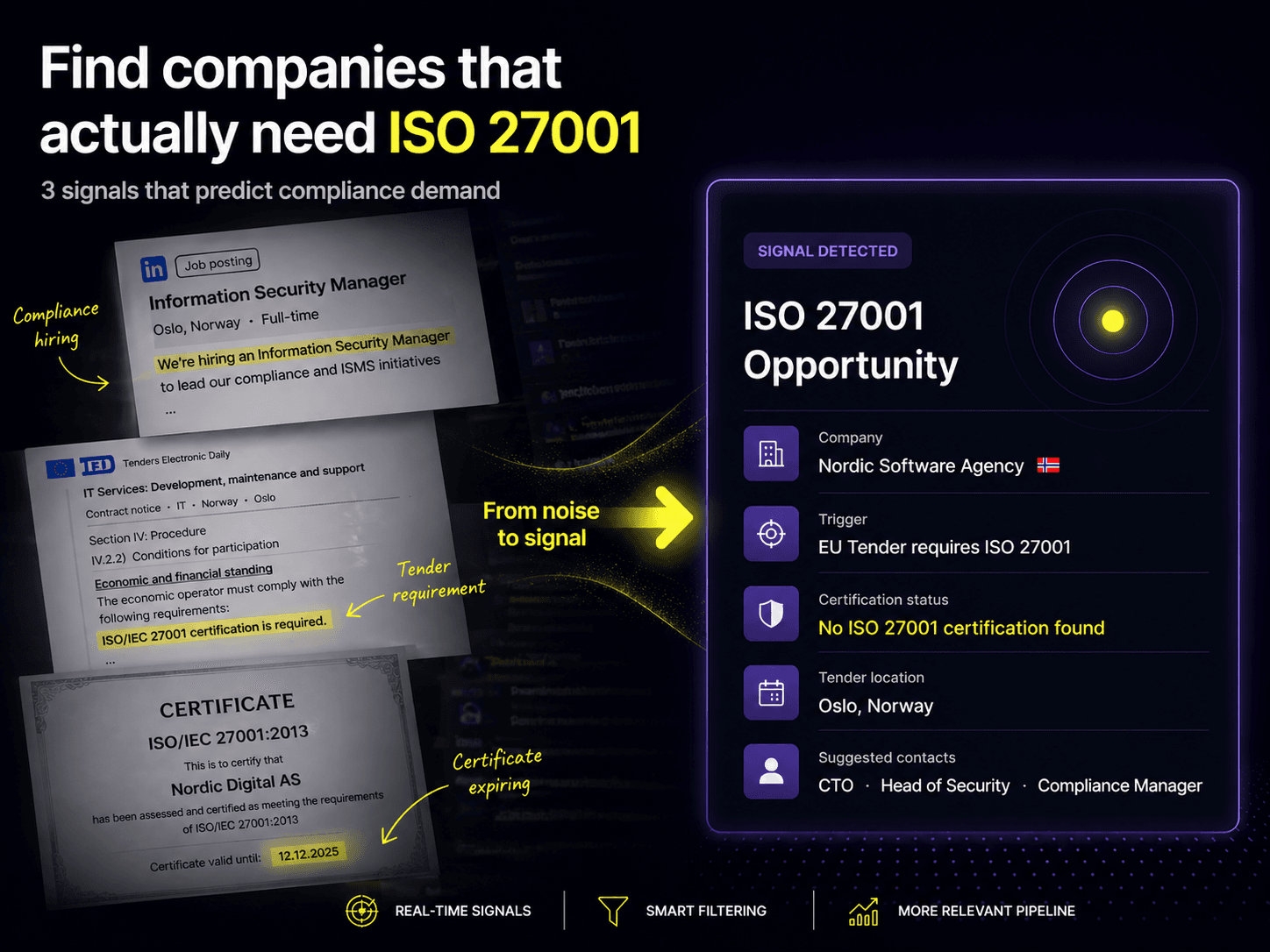
Most companies that sell ISO 27001 consulting, audit preparation, or compliance software start from a broad list of potential customers.
That is usually where the problem begins.
A generic list can tell you which companies operate in IT, cybersecurity, software development, or public-sector services. It cannot tell you which of those companies have a reason to care about ISO 27001 right now.
The better question is not "who could be a customer?" The better question is "what happened that makes certification relevant this month?"
ISO/IEC 27001 is the international standard for information security management systems. It helps organizations establish, maintain, and improve how they manage information security risks. ISO describes it as the best-known standard for ISMS, and it applies to companies of different sizes and sectors. ISO/IEC 27001.
For companies selling into this market, demand is often visible before the buyer fills out a form. You can see it in hiring patterns, public tenders, and certificate expiry data.
This article explains three signals that can help ISO 27001 providers find better-fit accounts across Europe.
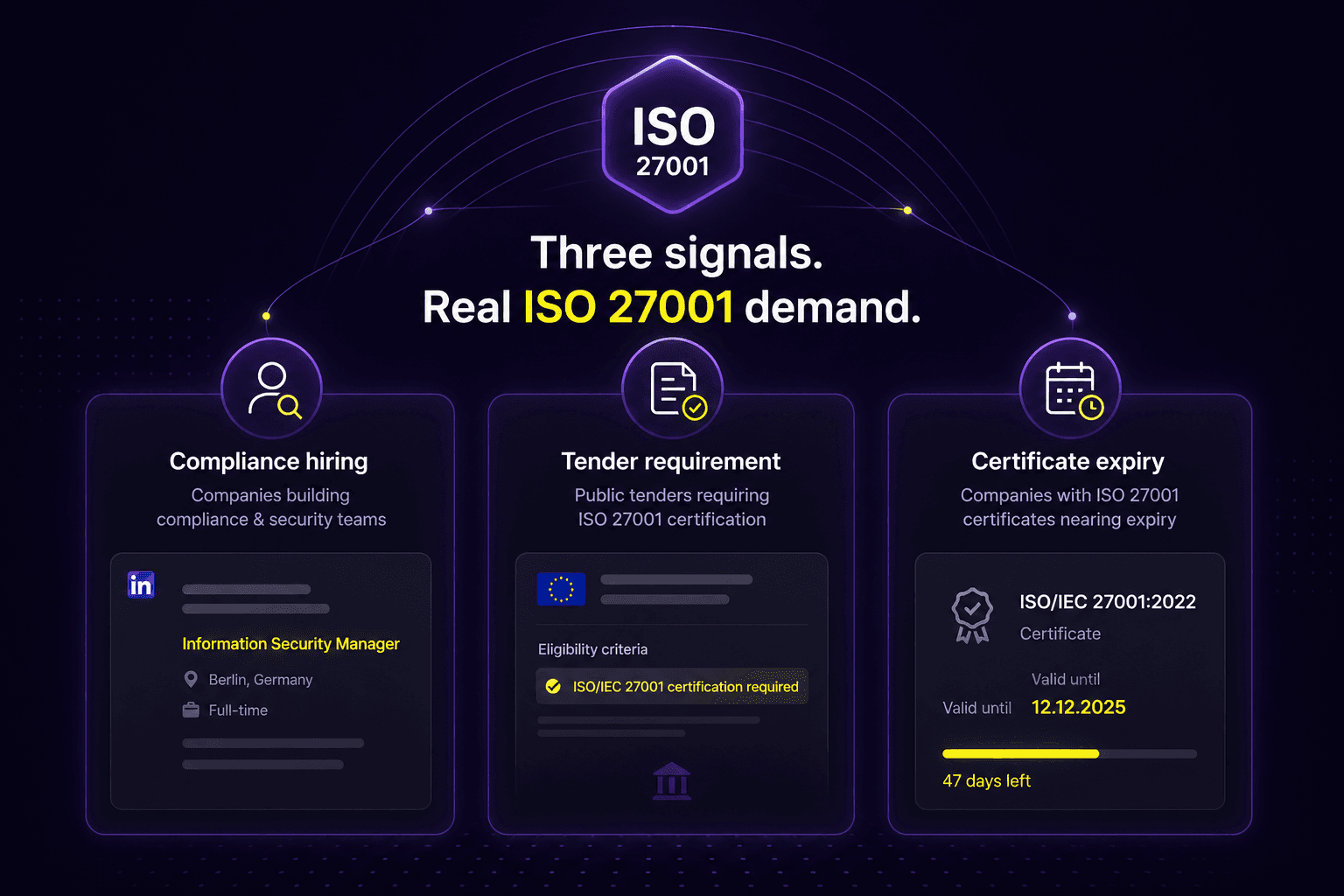
Visual summary: the 3 signals
| Signal | What it indicates | Sales angle |
|---|---|---|
| Compliance and security hiring | Internal investment and readiness build-out | ISO roadmap support |
| Tender requirements | External pressure from procurement eligibility | Tender access and supplier qualification |
| Certificate expiry windows | Deadline-driven renewal urgency | Audit preparation and recertification support |
Why ISO 27001 demand is easier to track than most people think
ISO 27001 is not usually a random purchase.
A company does not wake up one morning and decide to become certified for no reason. There is usually pressure behind the decision. Sometimes it comes from a customer. Sometimes from a public tender. Sometimes from an internal security push. Sometimes from an existing certificate that is approaching renewal.
That pressure creates a timing window.
For consultants and software vendors, this is where the opportunity sits. The goal is not to convince every software company that ISO 27001 matters. The goal is to find the companies already moving toward a situation where certification becomes useful, urgent, or unavoidable.
Signal 1: Companies hiring for compliance and security roles
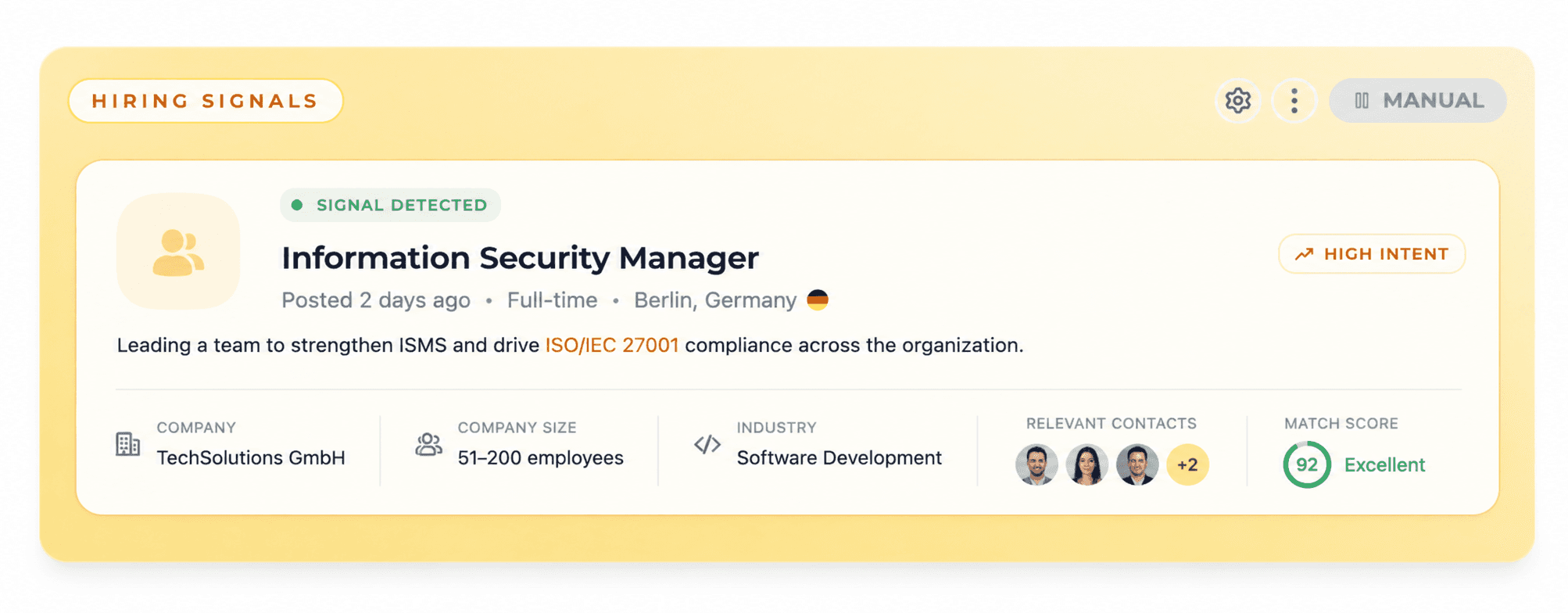
Hiring is one of the earliest signs that a company is building internal capability around compliance.
If a company starts hiring an Information Security Manager, ISMS Manager, GRC Lead, Compliance Manager, Internal Auditor, or IT Governance Manager, there is a good chance that security processes are becoming more formal inside the business.
That does not always mean the company is starting ISO 27001 tomorrow. It does mean something has changed.
Maybe an enterprise customer is asking for stronger security controls. Maybe the company is preparing for audits. Maybe leadership wants to sell into larger customers or public-sector accounts. In each case, the hiring activity gives you a concrete reason to start a relevant conversation.
A normal lead list might give you 1,000 software companies in Germany.
A hiring signal gives you a smaller group of companies that are actively investing in compliance, security, or governance.
That difference matters.
"Saw you are hiring around compliance and information security. When companies start building that function internally, ISO 27001 readiness often becomes part of the roadmap. Are you already working on certification or still mapping the process?"
Signal 2: EU tenders that require ISO certification
Public procurement is one of the strongest places to look for ISO-related demand.
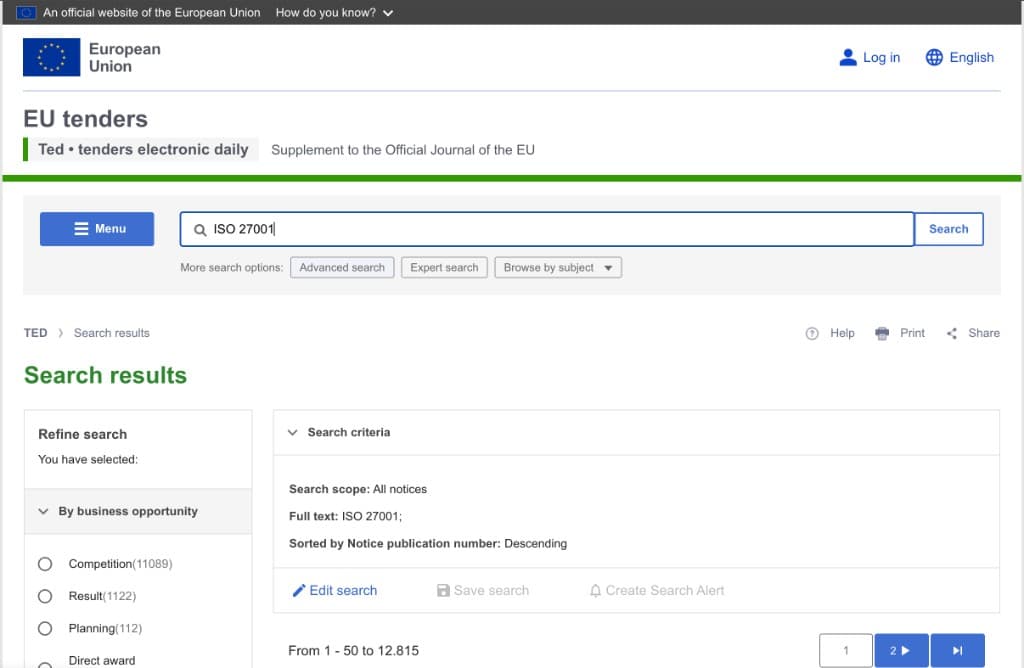
TED, Tenders Electronic Daily, is the official portal for European public procurement notices. It contains active notices published in the Supplement to the Official Journal of the European Union, and the advanced search lets users filter notices by criteria such as sector, CPV code, and place of performance.
This matters because public tenders often include requirements around certifications, security standards, quality standards, or supplier eligibility.
For ISO 27001 providers, the workflow is simple in theory but difficult to do manually at scale.
Step 1
Monitor relevant tenders where ISO requirements appear.
Step 2
Match opportunities with local companies that could benefit.
Step 3
Prioritize accounts with an apparent certification gap.
First, monitor tenders in relevant sectors such as IT services, cybersecurity, cloud infrastructure, managed services, software development, and public-sector technology. Then identify tender documents where ISO 27001, ISO 9001, or similar certifications appear as eligibility or evaluation criteria. After that, map companies in the relevant geography that could plausibly apply. The final step is to check whether those companies already appear to have the required certification.
The interesting account is not just "a company in IT".
The interesting account is a company that could benefit from a public tender, but does not appear to have the certification needed to compete properly.
That creates a real reason to talk.
The message is no longer generic. It can be tied to eligibility, public-sector access, and a specific market opportunity.
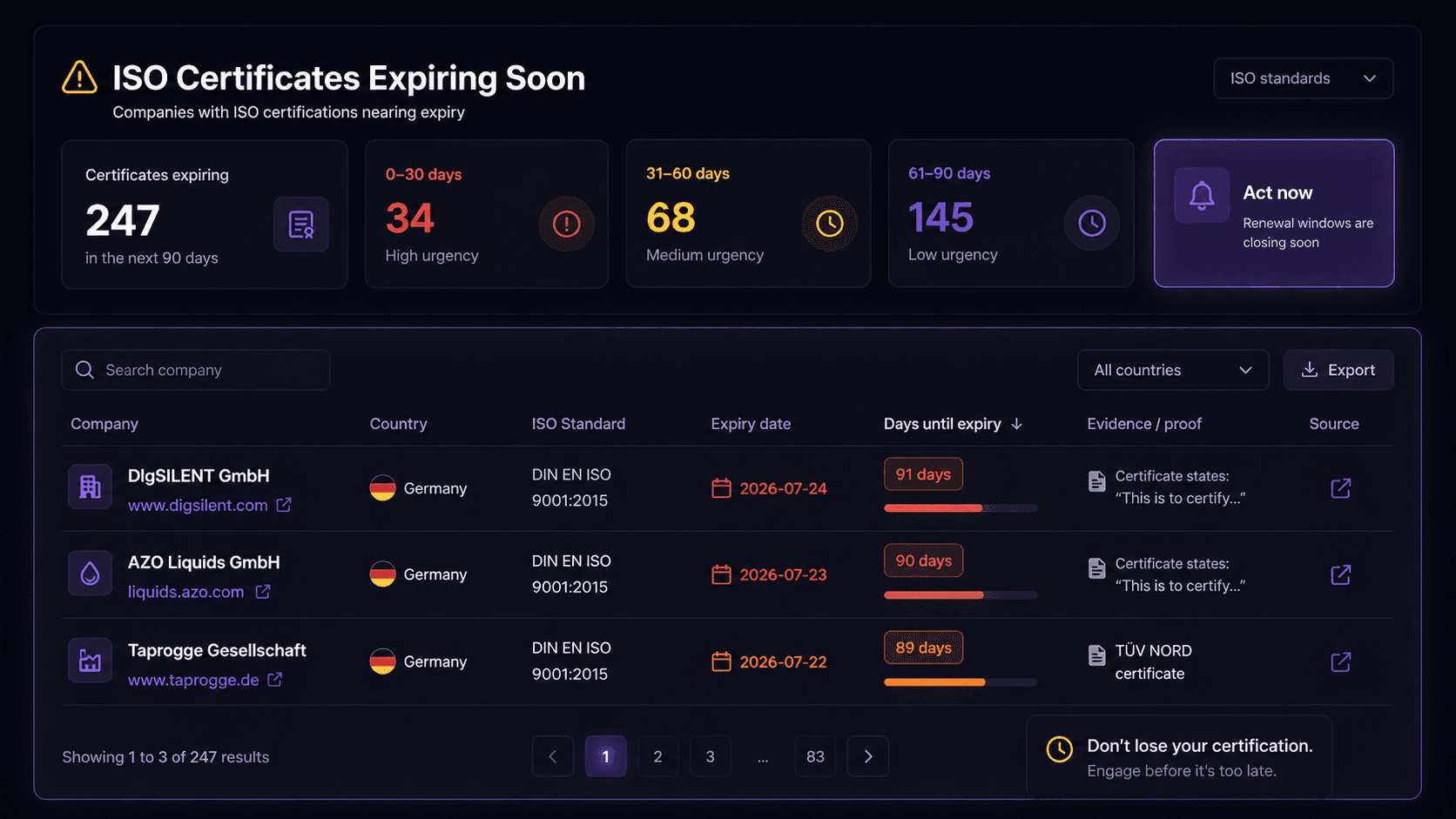
Signal 3: Companies with ISO certificates approaching expiry
The third signal is more direct.
If a company already has ISO 27001 and the certificate is approaching expiry, it is entering a renewal or recertification window.
ISO explains that accredited certifications can be verified through IAF CertSearch, and certification bodies or registries such as BSI and IQNET provide searchable certificate validation or certificate directory tools.
Many management system certifications follow a three-year cycle with surveillance audits during the certification period. AFNOR describes ISO 9001 certification as valid for three years with annual surveillance audits, and the same certification cycle logic is commonly applied across management system standards such as ISO 14001 and ISO 27001.
For a vendor, the expiry window is useful because the pain is already defined.
A company with a certificate expiring in 47 days may need help with evidence collection, audit preparation, internal documentation, corrective actions, workflow cleanup, or renewal planning.
The best window is usually not the final week before expiry. It is earlier, often between 20 and 90 days before the deadline, when the team still has time to act but the issue is close enough to matter.
How the tender signal worked in Oslo
One customer used this approach to find ISO 27001 opportunities around Oslo.
They were targeting software agencies that could benefit from public-sector and enterprise contracts, especially contracts where ISO-related requirements could influence supplier eligibility.
Instead of starting from a broad list of software companies, the campaign started from the tender market.
The workflow looked like this.
First, Karhuno monitored relevant tender opportunities in the Oslo area and identified where ISO 27001 or similar certification requirements appeared in the procurement context.
Then, the signal was matched against local software agencies that could realistically benefit from those opportunities.
Finally, Karhuno checked which companies did not appear to have visible ISO 27001 certification and prioritized the ones where the gap looked commercially relevant.
The result was a much smaller, but much stronger, target list.
Karhuno identified 32 companies that matched the logic. From those, the customer focused on the accounts where the certification gap was most relevant.
The campaign closed 7 deals.
The reason it worked was not volume.
It worked because the outreach was connected to a real business situation: access to tenders, supplier eligibility, and the ability to compete for contracts where ISO 27001 could matter.
That is the difference between a generic lead list and a signal.
A generic list says:
"This company might be a fit."
A signal says:
"This company has a reason to care now."
Qualified accounts
32
Closed deals
7
Primary advantage
Timing over volume
How Karhuno AI tracks ISO 27001 opportunities
Karhuno helps ISO 27001 consultants, certification providers, and compliance software companies find accounts where demand is already forming.
The three signals covered in this article - compliance hiring, tender requirements, and certificate expiry - each come from a different source.
Hiring data shows internal investment.
Tender data shows external pressure.
Expiry data shows deadline-driven urgency.
The first month is usually focused on building the signal logic for the customer's specific market: which countries to monitor, which company sizes to prioritize, which tender categories matter, and which job titles actually indicate ISO readiness.
Once validated, the model runs continuously.
Instead of doing manual research every week, the customer receives new opportunities as they emerge.
The goal is not more data.
It is a clearer reason to start the right conversation at the right time.
From one campaign to a repeatable signal system
The Oslo case worked because the customer did not treat ISO 27001 prospecting as a one-off list.
They used a signal that could be repeated.
The same logic can be applied to other markets.
In Germany, the signal might be companies hiring ISMS Managers while preparing for enterprise security requirements.
In the UK, it might be software providers with ISO certificates approaching renewal.
In the Netherlands, it might be IT service companies exposed to public-sector tender requirements.
In each case, the method is the same:
Find the business trigger.
Check whether ISO 27001 is relevant.
Verify the source.
Prioritize the companies where the timing is strongest.
Then reach out with a message that connects to the situation.
That is how ISO lead generation becomes more predictable.
Repeatable method checklist
- Find the business trigger.
- Validate ISO 27001 relevance.
- Verify the source quality.
- Prioritize by timing strength.
- Craft outreach tied to the current situation.
Related articles
Sales signals
5 signals that predict buying intent on LinkedIn
How to detect real outbound-ready accounts using LinkedIn engagement patterns.
Comparisons
Karhuno AI vs Perplexity for B2B buying signals
Why generic AI tools cannot replace a sales-grade buying-signal engine.
Comparisons
Karhuno AI vs ChatGPT, Claude, and Perplexity
A real B2B sales test against the Big Three generative AI tools.
Catch ISO 27001 demand before your competitors do
Karhuno turns hiring signals, tender requirements, and certificate expiry into clear outbound opportunities, with proof behind every signal.