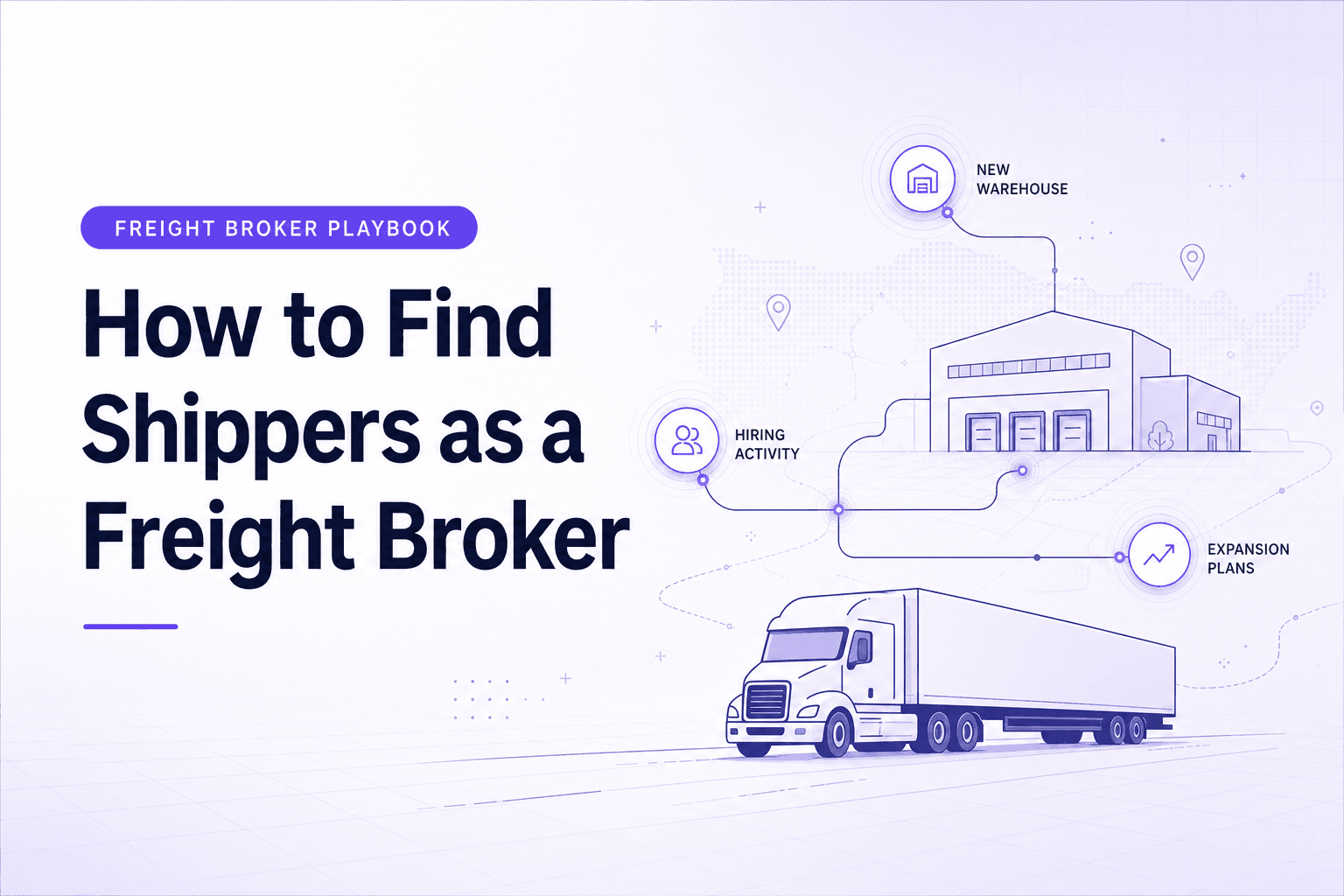
The brokers who build a book of business fast work differently. They reach a shipper at the moment a new shipping need appears — a distribution center opening, a plant expansion, a sudden round of logistics hiring. They call before the shipper has posted a single load.
This guide covers nine ways to find shippers as a freight broker or agent, from the basics every load-board blog repeats to the signal-based method almost nobody talks about.
How do freight brokers find shippers?
Freight brokers find shippers through load boards, referrals from current customers, cold outreach, industry directories, LinkedIn, and their own bill-of-lading data. The brokers who grow fastest add one more method: tracking buying signals like new facilities, expansions, and hiring, so they reach a shipper right when it needs freight moved.
Here's the full list, worst-to-first:
- Load boards
- Referrals from your current shippers
- Cold calling and cold email
- Your own bill-of-lading data
- Industry directories and trade associations
- LinkedIn and social selling
- Local manufacturers by freight type
- Buying signals
- Signal-based prospecting tools
Each one below, including who it's good for and where it falls apart.
What makes a shipper worth your time
Before the methods, a filter. A name is not a lead. A shipper is worth chasing when three things line up: they move freight on lanes you can actually cover, the volume is steady enough to matter, and they pay on time.
Five good-fit shippers beat two hundred random company names. Keep that in mind, because most of the methods below give you volume. Only a couple give you fit. The goal is to spend your calling hours on companies that have a reason to pick up.
1. Load boards
DAT, Truckstop, and 123Loadboard are where every broker starts. You get real loads, real-time, and a way to match capacity fast. That's the upside.
The downside is the crowd. Every other broker sees the same posting at the same second, margins get squeezed, and you're transacting, not building relationships. Use load boards to stay liquid and learn lanes. Don't expect them to build you a loyal shipper base.
2. Referrals from your current shippers
The cheapest shipper you'll ever land is the one a happy customer hands you. Ask directly. When a load goes well, ask the shipper if they know one other company that ships the kind of freight you handle.
There's a quieter version too. Look at the customers of your customers. If you're moving raw materials into a factory, the company on the other end of that supply chain ships finished goods out. That's a warm intro hiding in your own freight.
3. Cold calling and cold email
Cold outreach still lands shippers in 2026. The brokers who say it's dead are usually calling a bought list with no segmentation, reading the same script to a metals plant and a furniture importer.
What works now is a tighter list and a reason to call. Skip "do you have any freight today" and open with something specific to their business. Cold calling beats cold email for response, but email scales. Use both, and keep the list small enough that you actually know who you're calling. (More on building that list in method 8.)
4. Mine your own bill-of-lading data
You're sitting on leads already. Every bill of lading you handle names a shipper and a receiver. The party that isn't your customer is a prospect who already moves the kind of freight you cover.
After a clean delivery, call the side you don't work with yet. You've just proven you can handle their lane. That turns a cold call into a warm one.
5. Industry directories and trade associations
Trade groups, chambers of commerce, and industry directories list manufacturers and distributors by sector and region. Slower than a load board, but the contacts are real businesses that ship physical goods. Trade shows and regional conferences work the same way: more time, higher-quality conversations.
6. LinkedIn and social selling
Logistics and supply-chain decision-makers are on LinkedIn, and most brokers use it badly. Connecting and immediately pitching gets ignored. Posting useful things about lanes, capacity, and shipping costs gets you remembered.
The stronger play is reading LinkedIn for intent, not just posting to it. A logistics director complaining about carrier reliability is telling you something. We broke that down in 5 buying-intent signals on LinkedIn.
7. Search local manufacturers by freight type
A plain Google search by industry and city still works. "Plastics manufacturers in Memphis" or "cold storage distributors in Atlanta" gives you a starter list you can qualify by hand. It's manual and it doesn't scale, but for a niche freight type it puts real companies in front of you fast.
8. Buying signals: find shippers the moment they need freight
Here's the method the load-board blogs skip, and the one that changes how fast you grow.
A company doesn't become a shipper at random. Something creates the need. A new building gets leased. A plant gets built. Imports spike. A logistics team gets hired. Every one of those is a public, trackable event — and each one means a company is about to need freight moved that it isn't moving yet.
Find the event, and you reach the shipper before it goes shopping for a broker. You're not the eleventh cold call. You're the first person who noticed.
These are the signals worth tracking:
New distribution centers and warehouse openings
When a 3PL announces a 350,000-square-foot distribution center in Columbus, that's a shipper that will need outbound lane coverage it doesn't have today. A new DC means new freight flows, new origins, new destinations. We go deeper on this in warehouse buying signals and how to act on them inside 24 hours.
New manufacturing plants and facility expansions
A food producer breaking ground on a second plant in Texas will pull raw materials in and push finished goods out. Facility expansions, second locations, and new production lines all create freight that didn't exist last quarter.
Import surges and supply-chain hiring
Hiring tells you what's coming. An importer that just posted openings for a Logistics Coordinator and a Supply Chain Manager is scaling volume and building the team to handle it. Catch that, and you're talking to them while they're still figuring out their carrier strategy.
Funding rounds and fast growth
A DTC brand that just closed a $20M Series B is about to outgrow its current 3PL. Funded companies scale operations quickly, and scaling operations means more shipments on more lanes.
How to track signals: by hand vs automated
You can do this manually. Set Google Alerts for "new distribution center," watch construction permit news, check job boards for logistics roles, read funding announcements. It works, and it costs nothing but your mornings.
The problem is volume and timing. By the time you've found a signal by hand, read it, and matched it to a contact, days are gone and so is your head start. That's the gap the next method closes.
9. Signal-based prospecting tools and done-for-you shipper lists
This is where the manual signal hunt becomes a system. A handful of tools track expansion, hiring, and funding signals across thousands of companies, then hand you the company, the signal, the contact, and a reason to call — without you reading a hundred news sites every morning.
That's the category Karhuno sits in. Instead of a raw list of names, you get a shipper that just triggered a signal, the person to reach, and the angle that fits the event. You spend your time calling, not researching. If you want to see it on your own lanes, a free trial is the fastest way to test it. For the data side of how this works in Europe, see our breakdown of intent-data platforms.
Which method is fastest?
Not all nine pay off the same way. Here's how they stack up on the things that matter when you're trying to land a shipper this month.
| Method | Speed to first shipper | Cost | Lead quality | Competition |
|---|---|---|---|---|
| Load boards | Fast | Medium | Low–Medium | Very high |
| Referrals | Slow | Free | High | Low |
| Cold outreach | Medium | Low | Medium | High |
| BOL data | Medium | Free | High | Low |
| Directories | Slow | Low | Medium | Medium |
| Slow | Low | Medium | Medium | |
| Buying signals | Fast | Medium | High | Low |
One row gives you high lead quality and low competition at the same time. That's the whole argument for working from signals.
Common mistakes when prospecting shippers
A few things quietly kill broker pipelines:
- Buying a list and calling it cold, unsegmented. A 10,000-name list you read the same script to is worse than 50 names you actually understand.
- Living entirely on load boards. Fine for staying busy, bad for building anything that lasts past the next rate dip.
- Quitting after one no. Shippers switch brokers on their timeline, not yours. The "no" today is a "maybe" when their current broker drops a load.
- Ignoring timing. Calling a stable shipper that's happy with its broker is a waste. Calling one the week it opens a new DC is a layup.
FAQ
- How do new freight brokers get their first shipper?
- Start with the people you can reach without a budget: referrals, your own bill-of-lading data, and a small, well-segmented cold list. New brokers land faster by targeting companies with a fresh shipping need, like a new location or a hiring spree, rather than calling random names.
- How do freight agents find shippers?
- A freight agent finds shippers the same way a broker does, working under a licensed brokerage's authority. The advantage is you can lean on the brokerage's resources and reputation while you prospect through referrals, cold outreach, and buying signals.
- What's the best way to find direct shippers instead of using load boards?
- Work from triggers. Track new facilities, expansions, import activity, and logistics hiring, then reach the company directly before it posts loads on a board. Your own delivery data and customer referrals also point you to direct shippers that never touch a load board.
- How many shippers does a freight broker need?
- Fewer than you'd think, if they're the right fit. A handful of steady shippers on lanes you cover well will outperform a long list of one-off accounts. Quality and lane fit beat raw count.
- Is cold calling still effective for finding shippers in 2026?
- Yes, when the list is tight and the opening is specific. Cold calling a segmented list with a real reason to call still gets shippers on the phone. Reading a generic script to a bought list does not.
- How do freight brokers find companies that need freight moved?
- By watching for the events that create freight: new distribution centers, plant openings, funding rounds, and supply-chain hiring. Each one signals a company that's about to move goods it isn't moving yet.
The bottom line
Knowing how to find shippers as a freight broker isn't about calling more. It's about calling the right company a week before the competition knows it exists. Load boards and cold lists keep you busy. Signals get you there first.
Want to see which shippers in your lanes just triggered a signal?