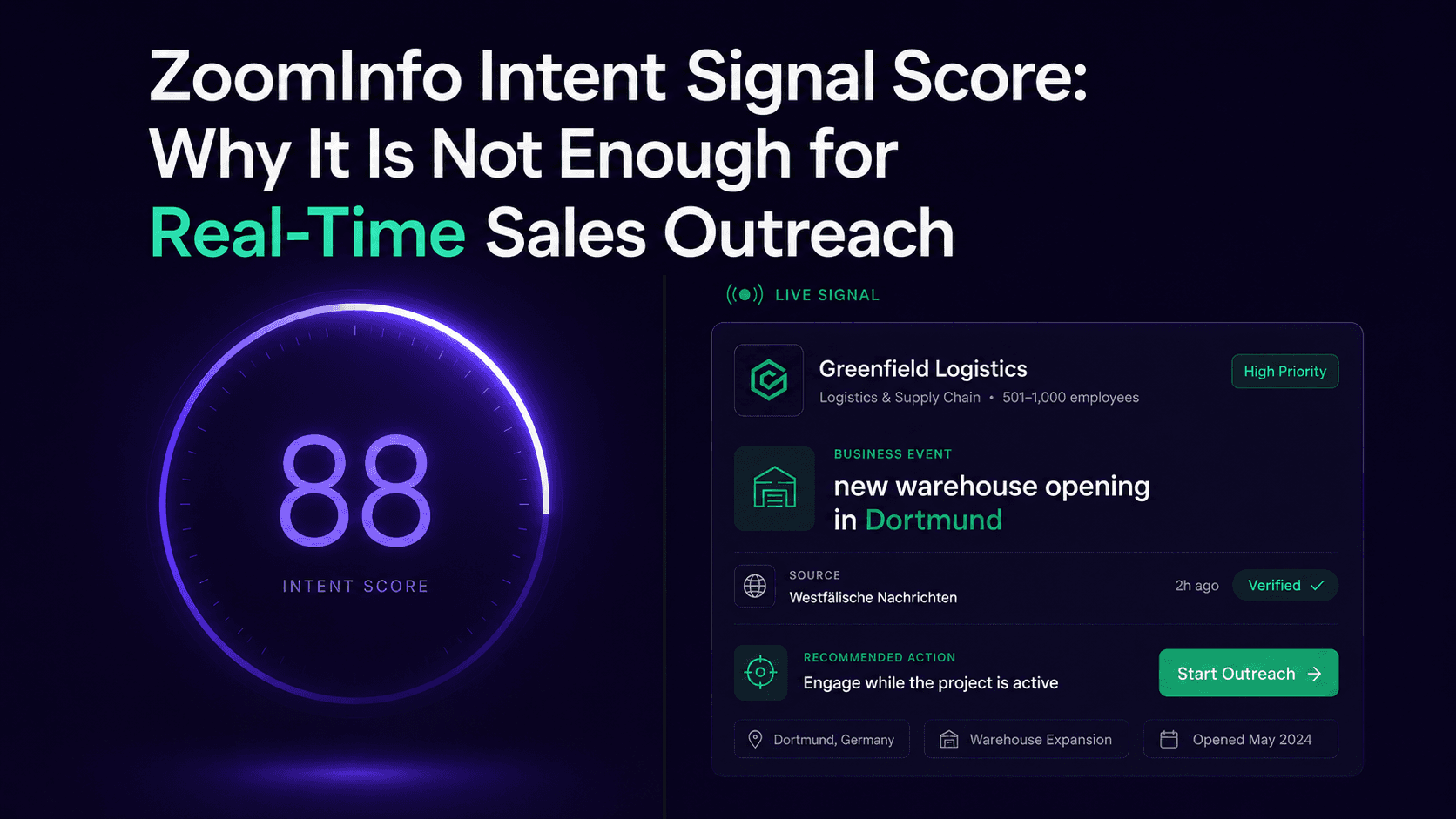
A score is a number. It does not tell a rep what actually happened inside the account, why that account matters this week, or what specific event to reference in the first line of an email. So the data sits in the CRM, gets filtered into a list, and reps still end up writing generic emails on top of it.
That is the gap most B2B teams hit with intent data, buyer intent data, and sales intent platforms. They surface interest. They do not always give you a reason to start a conversation today.
ZoomInfo is one of the best-known intent data providers around. Its Intent product flags companies researching relevant topics and surfaces account-level metrics like Intent Signal Score and Audience Strength. The Signal Score reflects how strong a company's interest in a topic is, based on recent content consumption compared to its historical behavior.
Useful? Sure.
But if your sales motion lives or dies by timely, personalized outreach, here is the real question:
Is an intent score enough to tell a rep what to say and why now?
Usually, no.
What Is ZoomInfo Intent Signal Score?
ZoomInfo's Intent Signal Score is part of the broader ZoomInfo Intent and ZoomInfo buyer intent stack. The platform tracks online research behavior around business topics and flags companies showing more activity than their baseline.
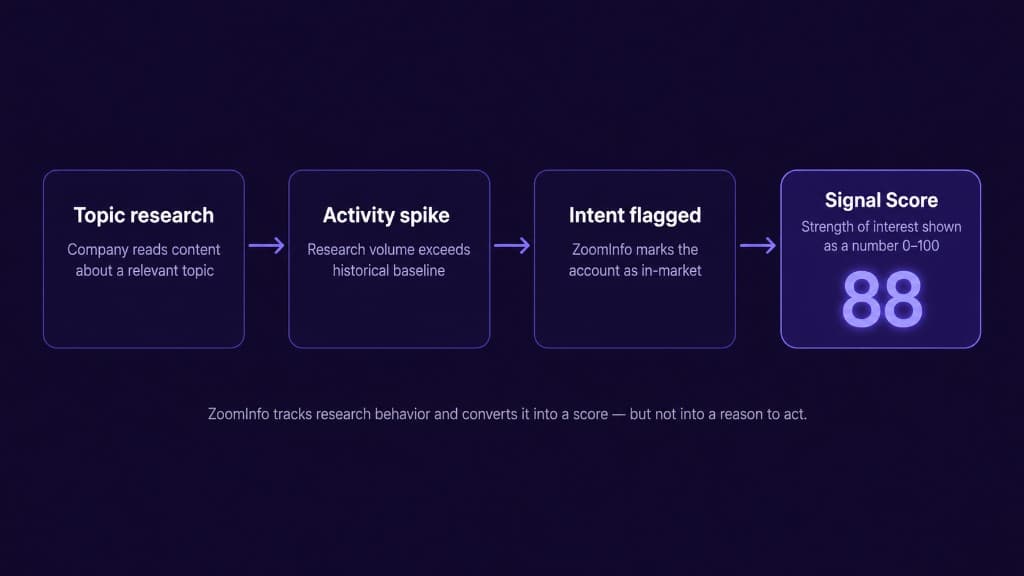
In simple terms:
- a company researches a relevant topic
- that activity goes above normal levels
- ZoomInfo flags the account as showing intent
- the Intent Signal Score shows the strength of the signal
ZoomInfo also wires intent signals into contact data and CRM workflows, which makes prioritization easier.
For sales and marketing teams, this layer of B2B intent data has real value when you are building account lists, picking segments, or deciding which companies deserve attention first.
The catch: the score is an abstraction. It tells you something may be happening inside an account. It does not always tell you what.
Why the Intent Signal Score Is Useful — But Limited
To be clear: ZoomInfo intent data is not useless. Intent scoring genuinely helps with:
- account prioritization
- ABM audience building
- lead scoring
- spotting companies researching relevant categories
- cutting down on pure cold prospecting
ZoomInfo itself positions intent data as a way to reach companies while they are actively researching solutions.
The problem shows up when teams try to use an intent score as the only basis for outbound messaging.
A rep opens the CRM and sees:
Account: Company X
Topic: Warehouse Management Software
Intent Signal Score: 88
Now the questions start:
- What actually triggered the score?
- Was it one person reading a broad article?
- Was it a spike across multiple stakeholders?
- Was the research tied to an active project, or someone writing a blog post?
- Is there a real business change behind it?
- What does the rep reference in the email?
Without that context, an intent score tells you who to prioritize. It does not tell you how to open the conversation.
The Core Problem: a Score Does Not Explain the "Why Now"
For real-time outbound, sales teams need more than buyer intent software. They need a reason to act.
That reason is usually a concrete business event:
- a company opening a new warehouse
- a logistics team hiring a new Head of Operations
- a manufacturer expanding into a new region
- a business announcing funding
- a prospect engaging with a competitor's post
- someone publicly discussing a pain point on LinkedIn or Reddit
These are real buying signals in sales because they give you a practical reason to reach out.
Karhuno AI is built around that layer. We find real-time buying signals from public sources, LinkedIn conversations, hiring activity, expansion news, competitor engagement, warehouse openings, and social discussions, then attach the source so reps can read the trigger themselves before they write.
The difference between the two:
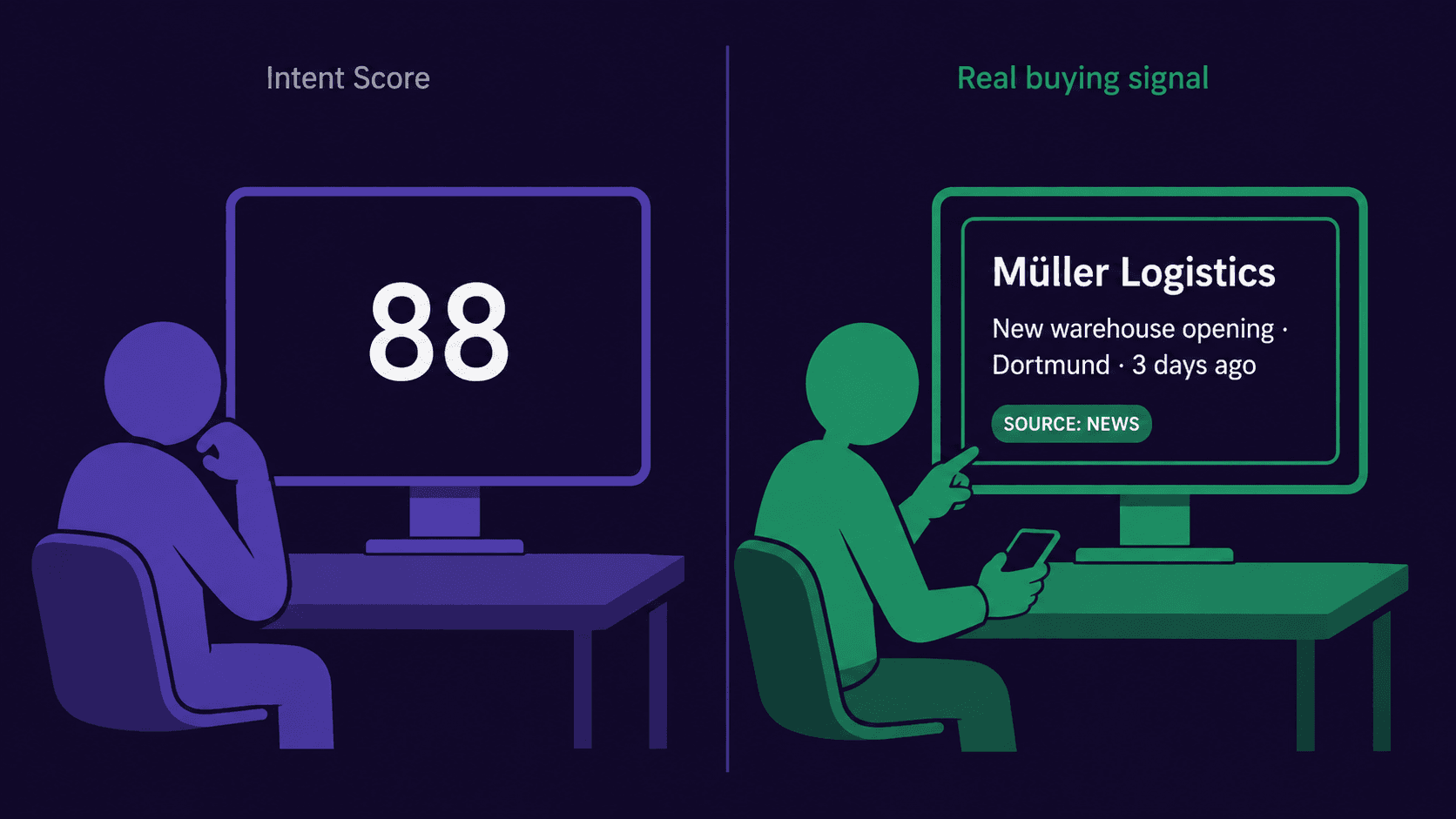
An intent score says: "This company may be interested in a topic."
A real buying signal says: "This company announced a new distribution center in Texas last week, which probably creates a need for WMS, automation, staffing, or facility services."
One gives you direction. The other gives you a first line.
For facility-led demand in practice, see our overview of warehouse buying signals.
Intent Data vs Real Buying Signals
The practical difference looks like this:
| Question | Intent data | Real buying signals |
|---|---|---|
| What does it show? | Interest around a topic | A concrete company event or behavior |
| Example | Research activity on "warehouse automation" | Company announces a new warehouse opening |
| Main value | Prioritization | Outreach timing and personalization |
| Can a rep cite the reason directly? | Often not clearly | Yes, with source proof |
| Best use case | Scoring and account selection | Trigger-based outbound |
ZoomInfo Intent surfaces accounts showing topic activity, so reps can prioritize. Karhuno AI focuses more narrowly on giving teams a specific, source-backed reason to contact a company now.
This is not really an either/or thing. Plenty of teams get value from running intent data for market prioritization and real-time sales signals for the actual outreach. If you are also comparing workflow-heavy outbound stacks, our Clay alternatives guide walks through signal-centric options in more depth.
But if your reps keep struggling to turn data into personalized action, a score on its own is not the missing piece.
Why This Matters for Real-Time Sales Outreach
Outbound works better when the message feels timely and specific.
A generic email written off a hidden score reads like:
"I noticed your company may be exploring warehouse management software."
That sounds like nothing. Probably gets archived.
A message written off a real trigger reads like:
"Saw the announcement about your new warehouse opening in Ohio. Teams at that stage usually review inventory workflows, automation, and facility ops before launch — wondering how you're approaching it."
The second one works because the rep knows what happened, when it happened, why it matters, and how to connect it to what they sell.
This is where sales signals, buyer intent signals, and reading buying signals stop being theory and start being operational.
ZoomInfo itself acknowledges some of the common headaches with intent data: signal noise, freshness, and the difficulty of turning signals into actual workflow.
That is the issue in a nutshell.
A sales team does not just need more accounts flagged with intent. It needs usable reasons to open conversations.
The Limits of Topic-Based Intent for Outbound
Topic-based intent can be powerful at scale, but it leaves a lot of ambiguity.
Take a company showing increased activity around "AI lead generation." That could mean:
- someone is casually reading a trend article
- a marketer is doing background research for content
- a sales leader is evaluating vendors
- a founder is building an internal tool
- an agency is researching for a client
The intent signal exists. The context does not.
This is why sales teams keep asking for:
- more explainability
- proof attached to the signal
- external context
- decision-maker relevance
- a clear timing trigger
That is not a rejection of B2B buyer intent data. It is a reminder that intent gets more valuable when it becomes understandable and actionable.
Where ZoomInfo Intent Signal Score Still Makes Sense
ZoomInfo Intent Signal Score still has its uses.
- Account prioritization. If you already have a big target account list, intent scoring helps decide which accounts get attention first.
- ABM audience creation. Marketing teams use intent data to build segments for ads, nurture, or account-based programs.
- High-level market demand tracking. When multiple companies in a market spike on similar topics, that tells you something about category-level demand.
- CRM and workflow automation. ZoomInfo syncs intent data into Salesforce, HubSpot, and Dynamics, which makes mapping into existing workflows easier.
So no, ZoomInfo intent does not have zero value. The point is that real-time sales outreach usually needs a level of detail a score alone does not give you.
What Sales Teams Need Beyond an Intent Score
If your goal is outbound that feels relevant instead of automated, you need signals with five qualities.
- A concrete event. Something visible: an action, a change, a conversation behind the signal.
- Source proof. The rep should be able to open the article, job post, social post, or company announcement behind the trigger.
- Timing. The signal should make clear why this company is worth contacting now, not six months from now.
- ICP relevance. Not every trigger matters to every vendor. A new warehouse matters to WMS vendors, automation firms, staffing providers, and logistics consultants. It is not equally relevant to every B2B seller.
- Outreach context. The rep should know how to turn the signal into a sentence.
That is the line between intent data for sales and signal-based sales execution. When you are ready to compare plans, see our pricing page for current tiers.
How Karhuno AI Approaches Buying Signals
Karhuno AI helps B2B teams find real-time buying signals based on what is actually visible in the market and in conversations.
A few examples:
- company expansions
- warehouse openings
- hiring signals
- funding rounds
- LinkedIn demand signals
- competitor engagement
- social listening across public discussions
Karhuno is not really positioned as "more intent data." It is positioned around proof-backed outbound: giving sales teams a concrete reason to contact a company and a source they can quote in the email.
A few sample signals and why they matter:
| Signal | Why it may matter |
|---|---|
| Company opens a new warehouse | Operational systems, automation, staffing, facility needs |
| Prospect engages with competitor content | Active category awareness |
| Company hires RevOps leadership | New process or tool evaluation likely follows |
| Prospect discusses a pain point publicly | Immediate relevance for outbound |
| Business expands into a new market | New compliance, GTM, hiring, or systems needs |
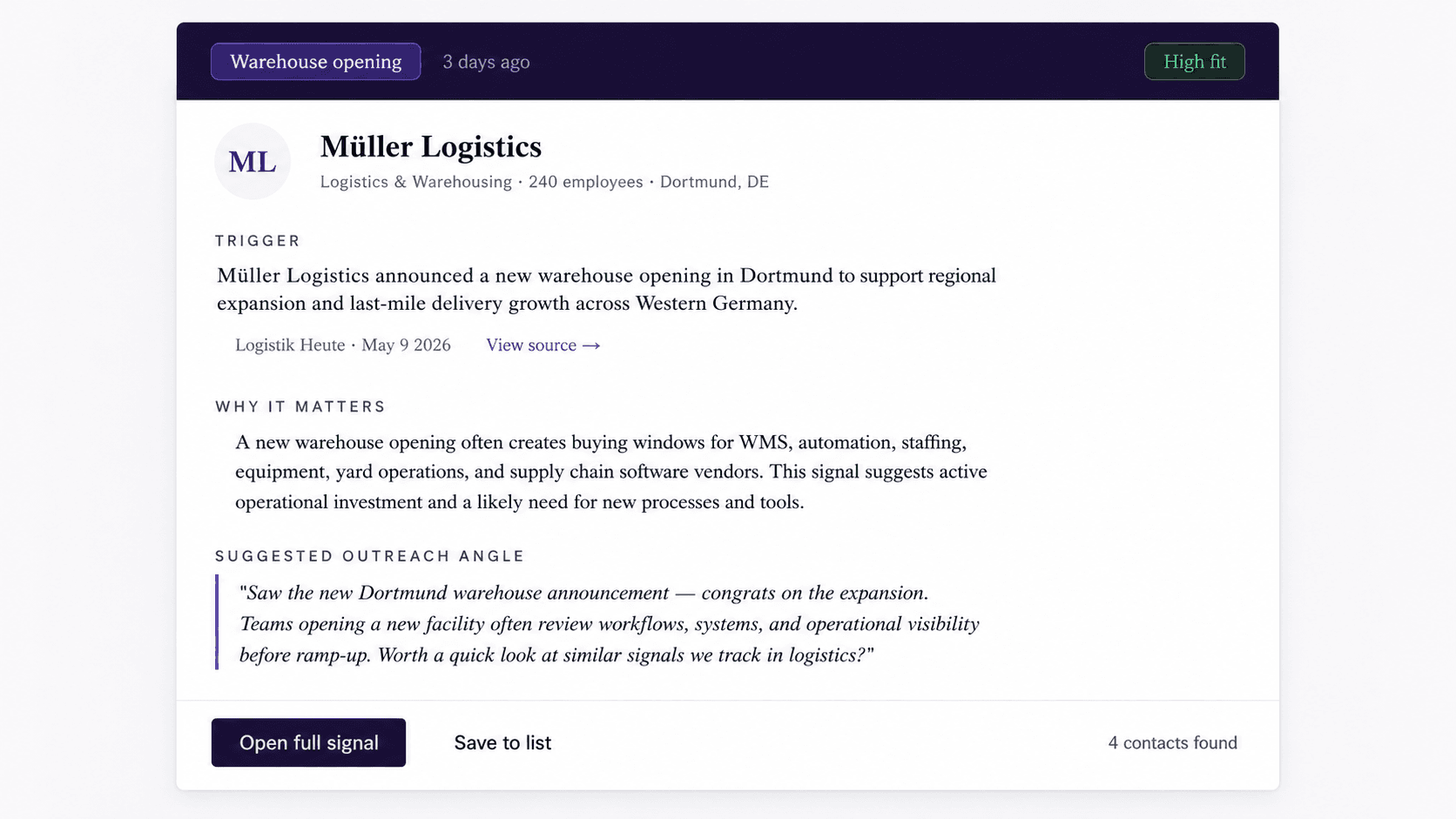
Instead of telling a rep "This company has an intent score of 91", Karhuno tries to give them: "This company just made a visible move that probably opens a buying window. Here is the source. Here is why it matters."
So, Is ZoomInfo Intent Signal Score Enough?
Depends on what you need it for.
If the goal is identifying in-market accounts at scale, building intent-based audiences, and prioritizing big target lists, ZoomInfo Intent Signal Score can absolutely help.
If the goal is writing timely outbound, referencing a concrete trigger, showing reps exactly why an account matters now, and personalizing outreach with proof — a score alone is usually not enough.
You need real buying signals. Not just abstract interest.
Final Take
Outbound is not going to be won by bigger prospect lists. It will be won by better timing, stronger context, clearer buying triggers, and personalization backed by something a rep can actually point to.
Intent data tells you where interest may exist. Real buying signals tell you why a specific conversation should start now.
That is the difference that matters.
Want to Find the Real Buying Signals Behind Your Market?
Prefer email first? Use our contact form and we will route you to the right person.
Karhuno AI tracks the events, conversations, and company moves that create real outreach opportunities. Warehouse openings, hiring activity, competitor engagement, public buying conversations — the kind of signals your reps can actually quote in an email.
Book a callFAQ: ZoomInfo Intent Signal Score and Buying Signals
What is ZoomInfo Intent Signal Score?
ZoomInfo Intent Signal Score is a metric showing how strong a company's interest in a topic is, based on recent content consumption compared to its historical behavior.
Is ZoomInfo intent data enough for sales outreach?
It helps with prioritization, but sales teams usually need more concrete context to write effective outbound — a source-backed business event or an observable trigger they can reference in the first line.
What is the difference between intent data and buying signals?
Intent data usually reflects topic-level research behavior. Buying signals are concrete indicators that a company is entering a relevant decision window: hiring, expansion, funding, public discussion of a pain point.
What are examples of buyer intent signals?
Topic research spikes, competitor engagement, hiring activity, new facility announcements, funding rounds, public pain-point discussions, product launches.
How can sales teams use real-time buying signals?
Prioritize accounts, personalize messaging, and reach out exactly when a business change creates a stronger reason to engage.